Where Did the “Quantum Drama” Begin?
World Quantum Day — April 14
Quantum mechanics is often described as strange, counterintuitive, and even unsettling. But where did this “quantum drama” actually begin?
The First Cracks in Classical Physics
At the beginning of the 20th century, physics seemed almost complete. Classical mechanics and electromagnetism were expected to explain everything.
Then came a series of discoveries that changed everything:
- Max Planck (1900) introduced the idea that energy is quantized
- Albert Einstein (1905) explained the photoelectric effect using light quanta
- Niels Bohr (1913) proposed a quantum model of the atom
Physics started to work better than ever — but at the cost of intuition.
Building the Foundations of Quantum Mechanics
In the 1920s, the theoretical framework of quantum mechanics took shape:
- Werner Heisenberg developed matrix mechanics
- Erwin Schrödinger introduced wave mechanics
Different mathematical approaches, same unsettling conclusion:
reality at the microscopic level does not behave the way we expect.
The Turning Point: Solvay Conference 1927
The debates reached their peak at the Solvay Conference in 1927.
Here, the greatest minds in physics gathered to confront a fundamental question:
Does quantum mechanics describe reality itself, or only the outcomes of measurements?
On one side:
- Albert Einstein — convinced that physics should describe an objective reality
On the other:
- Niels Bohr — defending what would later be called the Copenhagen interpretation
This was not just a scientific disagreement.
It was a philosophical divide that still shapes modern physics.
From Debate to Entanglement
The consequences of this debate did not end in the 1920s.
They led to:
- the famous EPR paradox
- the concept of quantum entanglement
- decades of experiments testing the foundations of reality
Even today, we are still exploring the implications of these ideas — both in theory and in emerging technologies such as quantum computing.
Recommended Reading
If you want to understand this story in depth, one book stands out:
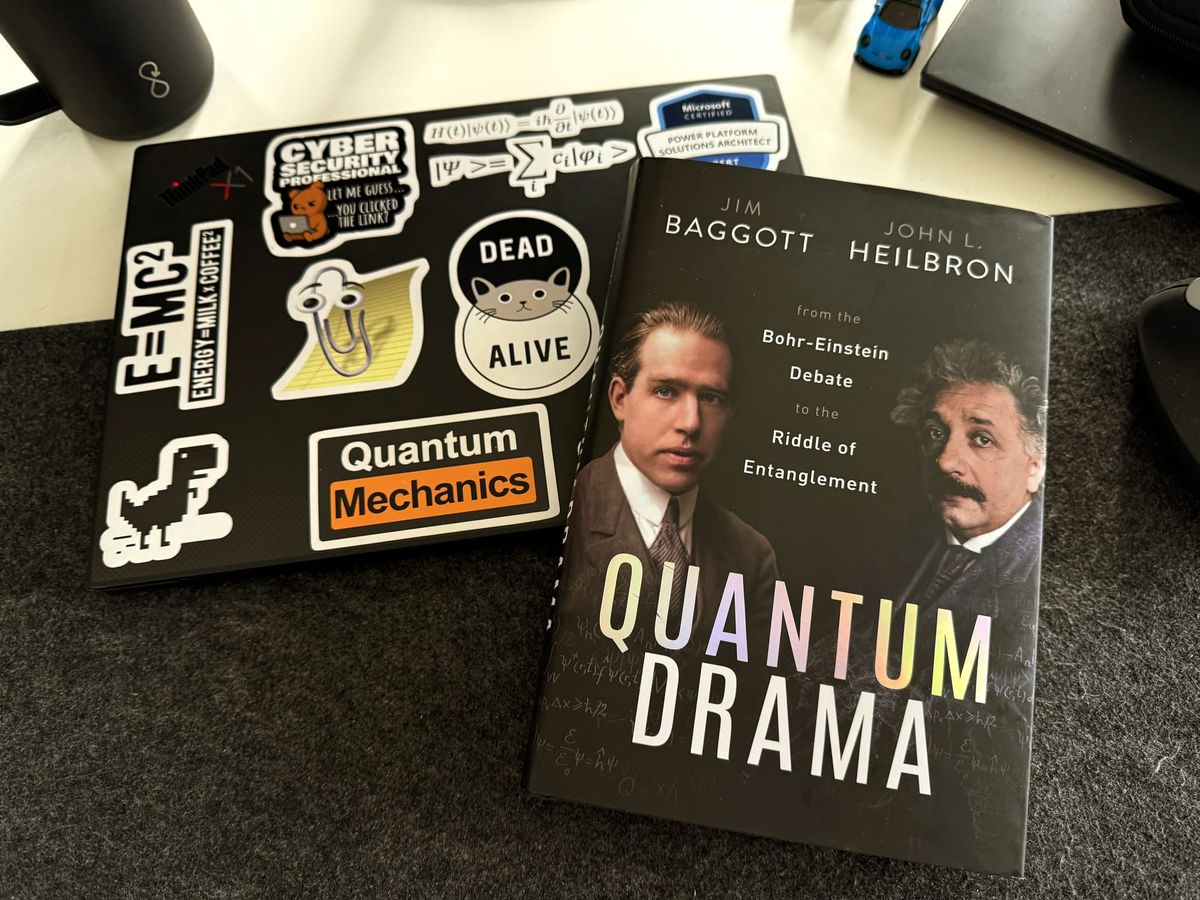
“Quantum Drama: From the Bohr–Einstein Debate to the Riddle of Entanglement”
by Jim Baggott and John L. Heilbron
It is not just a history of quantum mechanics.
It is a story of intellectual conflict, competing visions of reality, and questions that remain unresolved to this day.
Why It Still Matters
More than a century later, quantum mechanics is at the core of modern technologies — from semiconductors to quantum computers.
And yet, the original question remains open:
Are we describing reality… or only what we can observe?